
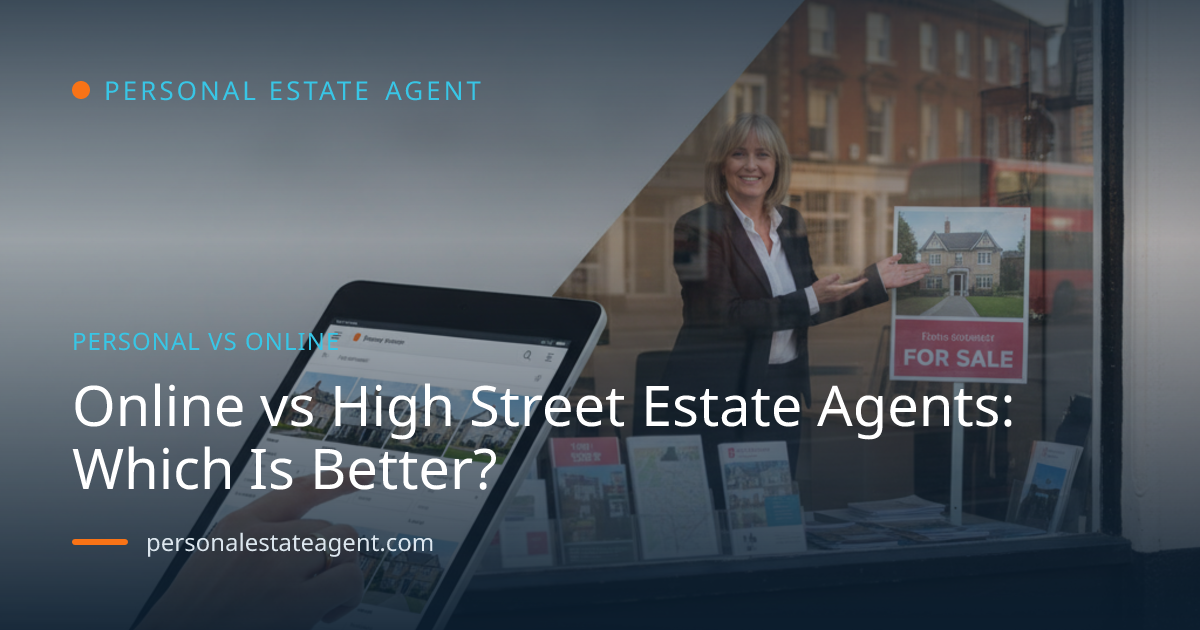
Choosing between an online and high street estate agent is one of the biggest decisions you'll make when selling. Here's what sellers really need to know.
Key takeaways
- Online agents charge lower upfront fees but often require payment whether your home sells or not — high street agents typically charge a percentage only on completion.
- High street agents offer local knowledge and accompanied viewings, but service quality varies enormously between branches and individual negotiators.
- A personal or hybrid estate agent can combine the best of both worlds: dedicated one-to-one service, local expertise, and competitive fees — without the anonymity of a call centre.
- The cheapest agent rarely secures the best price. A small difference in sale price can easily outweigh the fee saving from going online.
- Continuity matters: knowing who is handling your sale — and that they're motivated to complete — makes a measurable difference to your outcome.
Selling your home is likely the largest financial transaction you'll ever make, so choosing the right estate agent deserves more than a quick Google and a gut feeling. The debate between online and high street agents has run for over a decade, but the honest answer is that neither model is perfect — and there's now a third option worth knowing about.
What's the actual difference between online and high street estate agents?
Online estate agents list your property on Rightmove and Zoopla for a fixed upfront fee — typically paid regardless of whether you sell — and handle much of the process remotely. High street agents charge a percentage of the sale price, only paid on completion, and operate from local branches with staff who (in theory) know the area.
The distinction sounds simple, but the reality is more nuanced. Some online agents now offer optional extras — accompanied viewings, dedicated account managers, negotiation support — that push their total cost closer to high street levels. Meanwhile, many high street branches have grown so large that your sale is managed by whoever happens to be on duty that day.
It's worth understanding a third model too: the personal estate agent (sometimes called a hybrid estate agent). These are self-employed agents, often backed by networks like eXp UK, who combine local knowledge and genuine one-to-one service with technology-driven marketing — typically at fees that sit between the two traditional models. You can read more about how this works in our guide to what a personal estate agent is and how it differs from a chain.
How much do online vs high street estate agents charge?
Online agents typically charge between £500 and £1,500 upfront, while high street agents usually charge between 1% and 3% of the sale price — only due on a successful completion.
On a £350,000 home, a 1.5% high street fee comes to £5,250 — considerably more than an online agent's flat fee. But that comparison only holds if the two options achieve the same sale price, which is far from guaranteed. A well-negotiated extra 1–2% on the sale price can dwarf any fee saving.
Personal estate agents often charge somewhere between 0.75% and 1.5% on completion — meaning you get a motivated agent with skin in the game, without paying the premium of a large corporate branch network.
| Fee model | Typical cost | Paid when? | Negotiation included? |
|---|---|---|---|
| Online agent | £500–£1,500 fixed | Upfront (usually) | Often extra or limited |
| High street agent | 1%–3% of sale price | On completion | Yes |
| Personal / hybrid agent | 0.75%–1.5% of sale price | On completion | Yes — by your dedicated agent |
Fees vary by agent and region. Always read the full terms before signing.
Do online estate agents actually sell homes for less?
The evidence suggests online-only agents do tend to achieve slightly lower sale prices on average, though the gap has narrowed as the model has matured. A 2022 study by property data firm TwentyCi found that online estate agents had a higher fall-through rate than traditional agents — meaning more agreed sales collapsed before completion. Fall-throughs cost sellers time, money and stress, and are often linked to weaker buyer qualification and less proactive chain management.
That said, online agents have successfully sold millions of homes. For a straightforward property in a fast-moving market — a popular flat type in high demand, for instance — a competent online agent with good photography and correct pricing can do a perfectly reasonable job.
The risk rises when your sale is more complex: unusual property, difficult chain, motivated but emotionally invested seller, or a market that's softening. In those situations, having a single named agent who knows your home, has met your buyers and is personally motivated to get the deal across the line becomes genuinely valuable.
What are the pros and cons of high street estate agents?
High street agents bring local market knowledge, accompanied viewings, and a physical presence that some buyers and sellers find reassuring — but service quality is highly inconsistent, and fees are paid as a percentage regardless of how hard your agent actually works.
Advantages of high street agents:
- Local knowledge of comparable sales, schools, transport links
- Accompanied viewings and buyer feedback
- Active buyer databases built up over years
- No-sale, no-fee on most contracts
- Face-to-face relationship (at least at the start)
Disadvantages of high street agents:
- High fees, especially with large corporate chains
- Your sale may be passed between multiple negotiators
- Branch targets can lead to pressure to accept lower offers
- Variable quality — one branch of a national brand can be excellent, another poor
- Long tie-in periods (sometimes 12–16 weeks) can leave you stuck with an underperforming agent
What are the pros and cons of online estate agents?
Online agents are transparent on price, often tech-forward, and have improved significantly since the early days of Purplebricks — but the upfront fee model removes the financial incentive to actually complete your sale.
Advantages of online agents:
- Lower headline fees
- Easy-to-use digital dashboards for booking viewings and receiving offers
- Good-quality photography often included
- Rightmove and Zoopla listings (the portals that matter)
Disadvantages of online agents:
- Upfront fees are non-refundable if your home doesn't sell
- Limited local knowledge and negotiation support
- You often conduct your own viewings
- No single point of contact who knows your property well
- Higher fall-through rates, according to industry data
Does having a dedicated agent make a real difference?
Yes — consistently so. The agent who lists your home, knows its quirks, has met your buyers and understands your timeline is far better placed to negotiate, chase a chain and handle problems than a call-centre operative reading from a file.
This is the core argument for a personal or hybrid estate agent. Because they work for themselves — typically within a network that handles compliance, marketing tools and portal access — your agent has a direct financial interest in completing your sale at the best price. There's no branch manager to answer to, no colleague to hand your file to when they go on holiday.
If you're weighing up your options, it's worth looking at what's available in your area. You can browse personal estate agents near you or find out more about selling with a personal agent before making any decisions.
Which type of agent is right for your sale?
The right choice depends on your property, your market and how much hands-on support you want. As a rough guide:
- Online agent may suit you if your property is in high demand, straightforward, and you're comfortable managing viewings and chasing progress yourself.
- High street agent may suit you if you want no-sale no-fee, local branch support, and you've found a specific agent with a strong local track record — not just a well-known brand name.
- Personal / hybrid agent is worth serious consideration if you want continuity, genuine local knowledge, motivated negotiation and competitive fees — particularly for more complex sales or in a slower market.
Whatever you decide, interview at least two or three agents before signing anything. Ask specifically: who will handle my viewings? Who do I call if there's a problem? How many homes have you sold on this street in the last 12 months?
How do you find a good personal estate agent in your area?
The easiest way is to use a matching service rather than trawling through directories yourself. At Personal Estate Agent, you can match with a personal estate agent who knows your local market — without any obligation. It takes a few minutes and means you're comparing like for like, rather than guessing from a Google search.
The agent you're matched with will be self-employed, personally motivated and — crucially — the same person who lists your home, meets your buyers and sees the sale through to completion.
This article is general information only and does not constitute financial or legal advice. Always take independent advice before making decisions about selling your home.
Frequently asked questions
Is it cheaper to use an online estate agent?
Online agents charge lower upfront fees — typically £500–£1,500 — compared to 1%–3% for high street agents. However, upfront fees are usually non-refundable if your home doesn't sell, and lower negotiation support can mean a lower final sale price, potentially outweighing the saving.
Do online estate agents achieve lower sale prices?
Industry data, including a 2022 TwentyCi study, suggests online agents tend to have higher fall-through rates than traditional agents. Lower negotiation support can result in a lower achieved price, though outcomes vary significantly by property type, location and market conditions.
What is a hybrid estate agent?
A hybrid estate agent — sometimes called a personal estate agent — combines self-employed local expertise with technology-driven marketing, usually backed by a national network like eXp UK. They typically charge a completion-only fee and offer one-to-one service throughout the sale, unlike most online or branch-based agents.
Can I switch estate agents if I'm unhappy?
Yes, but check your contract first. Most high street agents include a tie-in period of 8–16 weeks, and some charge a withdrawal fee. Online agents may have already taken an upfront fee. Always read the terms around sole agency, tie-in duration and any cancellation charges before signing.
Do high street estate agents negotiate better than online agents?
Generally, yes — because a high street or personal agent is paid on completion, they have a direct financial incentive to achieve the best price. Online agents paid upfront have less motivation to push hard in negotiation, though individual agents within any model can vary significantly in skill.
How do I choose between an online and high street estate agent?
Consider your property type, local market conditions and how much involvement you want in the process. For complex or slower-moving sales, a dedicated personal agent offers continuity and motivation that online agents rarely match. Interview at least two or three agents before committing to anyone.
Leigh Brown
Founder & Personal Estate Agent
Leigh Brown has over 20 years' experience in residential sales and lettings across North and Prime Central London, with a reputation for a personalised, results-driven and relationship-based service. As a personal estate agent, Leigh works with a limited number of properties at any given time — staying hands-on through the whole sales and lettings process to achieve the best price for every client.
Ready to find your agent?
Answer a few questions and we'll match you with the personal estate agent who's right for your sale.
Find my match